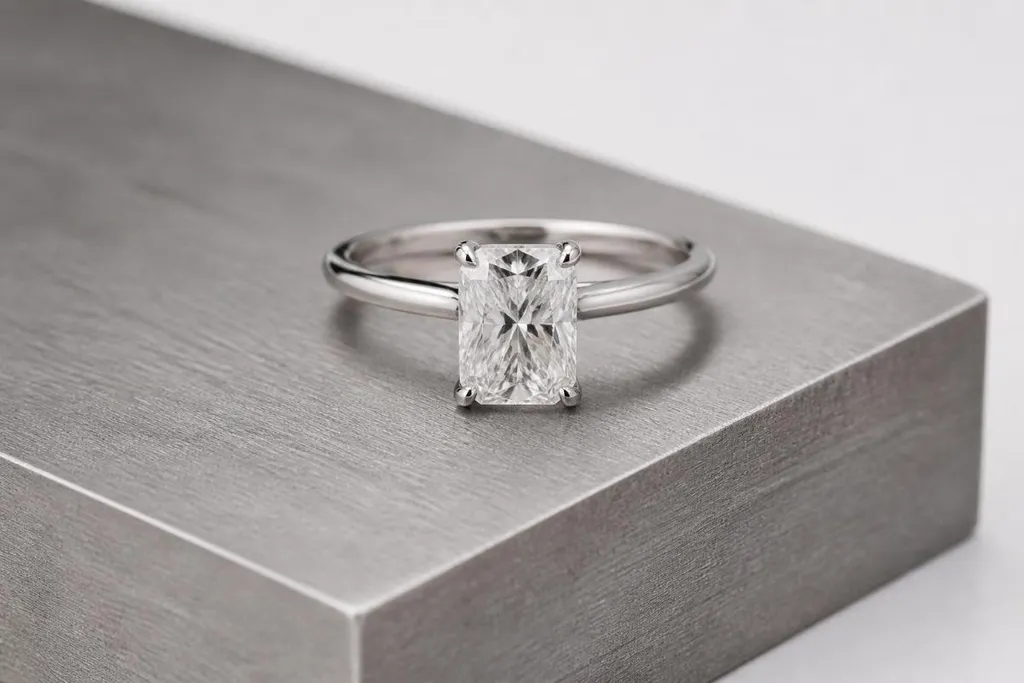
Some diamond shapes are defined by geometry; others are chosen primarily for sparkle. The radiant cut brings those qualities together. Its straight edges and cropped corners create a structured silhouette, while brilliant-style faceting gives the stone a lively play of light. The result feels polished and contemporary without losing the brilliance expected from an engagement ring.
Looking through beautiful lab diamond radiant cut rings demonstrates another advantage of the shape: radiant lab diamonds can vary considerably in proportion. Some are distinctly elongated, while others sit closer to a square. Combined with different bands and settings, those proportions allow the same cut to move from sleek and understated to bold and highly detailed.
What Gives a Radiant Cut Its Character?
A radiant diamond is immediately recognisable by its angular outline and trimmed corners. Those corners soften the strict geometry of a rectangular stone while also making the shape practical for a variety of setting styles.
Inside the diamond, brilliant-style facets create a very different appearance from the long, orderly steps of an emerald cut. Rather than producing broad flashes of light, a radiant typically offers more fragmented, energetic sparkle.
This distinction matters for someone attracted to rectangular diamonds but uncertain about the quieter appearance of a step cut. A radiant offers the clean lines associated with geometric shapes while retaining plenty of visual movement.
Its cropped corners can also give the stone a slightly softer personality than a sharp-edged rectangle, making it surprisingly adaptable across both minimalist and more decorative ring designs.
Square or Elongated: Proportion Changes Everything
Not all radiant-cut diamonds have the same outline. Length-to-width ratio has a significant influence on how the stone appears once set.
A squarer radiant produces a compact, balanced look and can create substantial visual presence around the centre of the finger. An elongated radiant draws the eye vertically, giving the ring a sleeker silhouette and often creating generous finger coverage.
Neither proportion should be treated as inherently superior. Someone might choose a 2-carat elongated radiant because its dimensions create the length and presence they want, rather than because the carat figure itself is impressive. Another wearer may prefer a smaller, squarer stone because its proportions work more naturally with their hand or chosen setting.
Actual measurements are therefore worth considering alongside carat weight. Diamonds of similar weight can distribute that weight differently, affecting how large they appear from above.
Choosing a Setting for a Radiant Lab Diamond
Radiant cuts work particularly well in settings that allow their outline to remain clearly visible. A solitaire is an obvious example. With little surrounding detail, the cropped corners and rectangular proportions become central to the design.
Diamond-set shoulders provide a different effect, extending sparkle along the band while maintaining the centre stone's defined silhouette. A halo can increase the overall face-up footprint, while a hidden halo adds detail beneath the centre stone without surrounding its outline from above.
Claw placement is important with angular shapes. The setting should protect and secure the diamond while avoiding unnecessary metal that obscures its characteristic corners.
Band width influences the composition as well. A fine band can make an elongated radiant appear particularly prominent, whereas a broader band creates a stronger, more architectural look. For larger centre stones, a slightly more substantial band may also provide better visual balance.
Consider Light, Metal and Everyday Wear
Radiant diamonds are valued for lively sparkle, but their appearance can vary under different lighting. Rather than judging one solely by specifications, it is useful to consider how evenly brightness and contrast are distributed across the stone.
Metal selection can reinforce the desired aesthetic. Platinum and white gold complement the crispness of the cut with a cool-toned appearance. Yellow gold provides stronger contrast and warmth, while rose gold can soften the diamond's angular character.
Practical considerations matter too. Setting height affects how prominent the stone feels and how easily the ring fits into everyday routines. The gallery should also be considered if the engagement ring will eventually sit alongside a wedding band.
Final Thought
Radiant-cut lab diamond rings appeal because they refuse to choose between structure and sparkle. Their geometric outlines provide definition, while brilliant-style faceting keeps the appearance energetic and bright.
The best choice comes from considering proportion as carefully as carat weight. Whether square or elongated, understated or accompanied by additional diamonds, a well-balanced radiant cut offers a distinctive combination of crisp design and lively brilliance that can remain compelling well beyond current trends.